
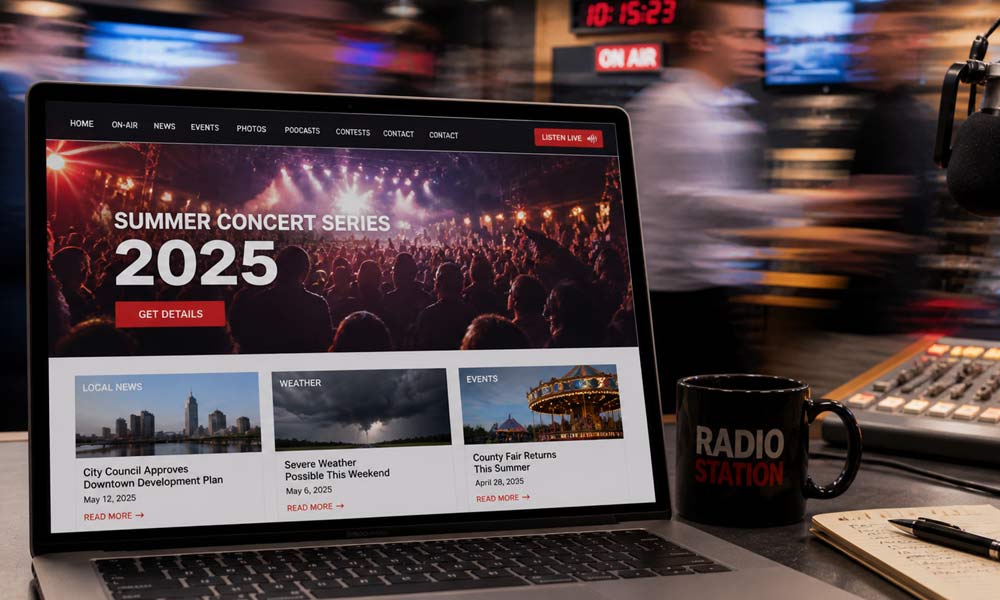
It’s an uncomfortable question, but it’s an honest one—and it’s probably closer to reality for some stations than they’d like to admit. Not because anyone intentionally decides to abandon their website, but because content quietly slips down the priority list. A busy stretch on-air, a short-staffed week, a few competing priorities, and before long the updates slow down. Then they stop.
What makes this situation tricky is that nothing immediately breaks. Your site still loads, your stream still plays, and everything looks fine on the surface. That lack of immediate consequence is exactly why it’s so easy to let it happen.
The real impact shows up later, and it doesn’t arrive all at once.
The Slow Shift Search Engines Notice First
Search engines—especially Google—pay close attention to how often a site is updated. It’s not just about what you publish, but how consistently you publish it. A steady flow of new content signals that your site is active and relevant, particularly for local information.
When that activity slows or stops, the signal changes. Your site doesn’t get penalized in some dramatic way, but it does begin to lose momentum. New pages take longer to get indexed, existing pages gradually lose their position, and competitors who are actively publishing start to edge ahead.
This is where many stations get caught off guard. They assume their existing content will continue to carry them, but search visibility is not something you can put on autopilot. It requires ongoing activity to maintain, and even more effort to rebuild once it’s lost.
Local Visibility Begins to Erode
For radio stations, this is where the stakes get higher. Your real advantage online isn’t competing nationally—it’s owning your local space. Searches related to community events, local news, weather impacts, and day-to-day information are where you should naturally show up.
When your site goes quiet, you slowly lose credibility in that space. Search engines begin to favor other sources that appear more current and more reliable. It doesn’t happen overnight, but over time your presence in those local results fades.
That means when someone in your market is actively looking for information you’re uniquely positioned to provide, your station is no longer part of the equation. That visibility doesn’t just shift to another media company—it often shifts to whoever is simply doing the work consistently.
Audience Behavior Changes Without Warning
The more subtle impact is on your audience, and this is the one that tends to stick. When a listener visits your site and sees outdated content, they don’t analyze it—they adjust their expectations. The next time they need information, your website is no longer top of mind.
This is how a destination quietly becomes an afterthought. Instead of being a place people check regularly, your site becomes something they only visit when prompted. That shift in behavior is difficult to measure in real time, but it has long-term consequences for engagement and loyalty.
Radio has always been built on habit. When your digital presence loses that habitual connection, it becomes significantly harder to rebuild.
The Ripple Effect Across Your Digital Platforms
Most stations don’t operate their website in isolation. Your mobile app, your push notifications, and even parts of your social strategy are all tied to the content you publish. When updates slow down, everything connected to that content begins to lose energy.
There are fewer reasons to send notifications, fewer opportunities to bring listeners back into your ecosystem, and fewer touchpoints that reinforce your brand throughout the day. What starts as a content issue quickly becomes a broader engagement issue.
This is where the impact becomes more visible, because it extends beyond the website itself.
Advertisers Feel It in the Numbers
Even if no one says it out loud, the effects show up in performance. Reduced content leads to fewer pageviews, shorter sessions, and less overall activity. That, in turn, makes it harder to position your digital platforms as valuable advertising channels.
Advertisers don’t just buy space—they buy attention. When your site is active and consistently updated, it creates more opportunities for that attention to exist. When it isn’t, those opportunities shrink, and the conversation around digital revenue becomes more difficult.
This is one of the reasons content consistency matters beyond audience engagement. It directly supports the business side of what you’re doing.
GEO and the Next Layer of Visibility
There’s also a newer factor that’s becoming increasingly important: how your content is surfaced in AI-driven search and discovery. As search continues to evolve, systems are placing more emphasis on fresh, reliable, and consistently updated sources when generating answers.
If your website hasn’t been updated in a while, it’s less likely to be included in those responses. That means you’re not just losing traditional search visibility—you’re also missing out on being part of how people discover information through newer tools and interfaces.
For stations that rely on being a trusted local source, that’s a meaningful shift. Visibility is no longer limited to search results pages; it’s becoming part of broader answer-driven experiences.
The Real Outcome Isn’t Sudden—It’s Gradual
If there’s one thing to take away from all of this, it’s that nothing about this process is dramatic. There’s no moment where everything stops working. Instead, it’s a gradual decline that’s easy to overlook until it becomes difficult to ignore.
Traffic softens. Engagement dips. Visibility narrows. Over time, your website plays a smaller and smaller role in your overall strategy.
That’s the real risk. Not failure, but irrelevance.
Staying Active Matters More Than Being Perfect
The solution isn’t to overwhelm your team or dramatically increase output. It’s to maintain a consistent level of activity that keeps your site relevant, useful, and visible. Regular updates signal to both search engines and your audience that your station is engaged and paying attention to what’s happening locally.
Consistency, more than volume, is what keeps your digital presence alive. When your website reflects the same ongoing energy as your on-air product, everything else—from engagement to revenue—has a much stronger foundation to build on.
And in a space where attention is constantly shifting, staying active is what keeps you in the conversation.
We want to help your radio station grow and succeed online. That journey starts with an amazing website that keeps visitors coming back often. Reach out to us to start your path to online success, or schedule an appointment to see our tools in action.