
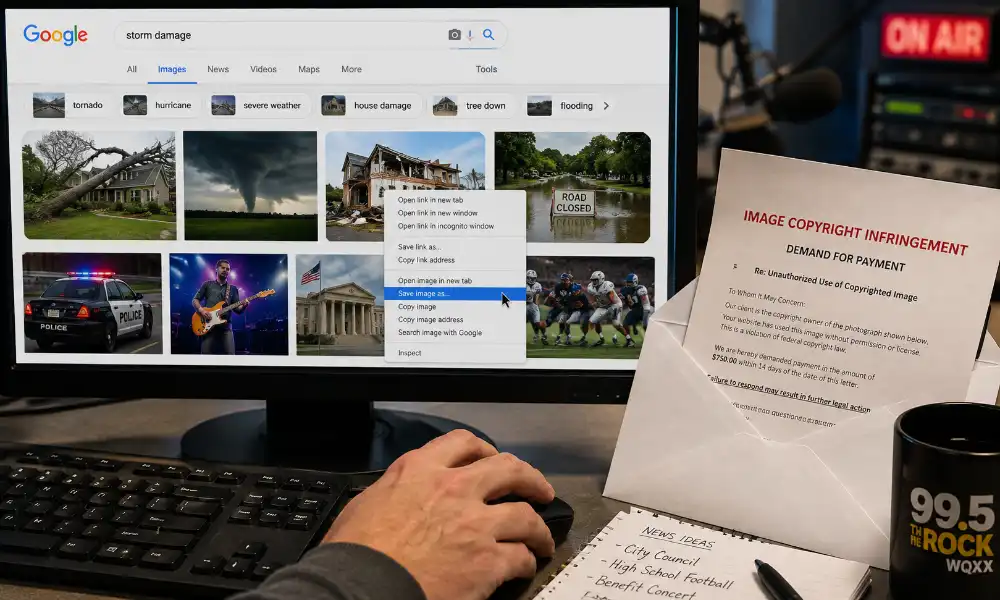
Another radio station contacted me recently after receiving an image copyright notice, and I doubt it will be the last. Somewhere along the way, someone needed an image for a story, found one online, uploaded it to the station website and moved on. Months or even years later, the station gets a letter or email claiming that photograph was used without permission and asking for money.
Before I go any further, I’m not an attorney and none of this should be considered legal advice. Copyright law can get complicated quickly, and if your station receives an infringement notice or demand for payment, talk with an attorney who can look at the specific circumstances. What I can speak to is what I’ve seen happen with radio station websites and some of the assumptions that repeatedly put stations in this position.
Whenever this happens, the conversation usually turns to why someone thought the image was okay to use in the first place. I’ve heard most of the explanations over the years, and many of them make perfect sense until you understand how copyright actually works. A radio station doesn’t have to knowingly steal a photographer’s work to find itself dealing with a copyright claim. Someone on the staff simply has to believe one of the myths we’ve passed around the Internet for years.
“Our website is too small for anyone to notice.”
There was probably a time when a small-market radio station could grab an image from somewhere and reasonably assume the photographer would never stumble across it. That’s a dangerous assumption today. Technology can locate copies of images across the web without someone manually visiting your website. Your station doesn’t need to be important enough for a photographer to notice. The image needs to be discoverable, and your website was built specifically to be discoverable.
“I found it on Google Images.”
Google Images shows you images. It doesn’t give you the rights to them. Think of it as a giant visual search engine pointing you toward photographs that exist on other websites. The fact that you can right-click an image and save it doesn’t mean you’re allowed to republish it any more than being able to copy an article from another newspaper means you’re allowed to paste the whole thing onto your station website.
“We’re using it for news, so it’s fair use.”
This one gets radio stations into trouble because there is a little truth buried inside it. News reporting is one of the purposes that can qualify for fair use under copyright law, but that doesn’t mean every photograph used with a news story automatically becomes fair use.
There are multiple factors considered in determining fair use, including whether the use is commercial in nature and whether it impacts the market for the original work. Simply putting someone else’s photograph above a news story doesn’t settle the question. If a professional photographer took a picture of a celebrity, tornado damage, a sporting event or a crime scene and licenses that photograph to publications, attaching it to your news story without permission doesn’t magically make that licensing business disappear.
“We’re not making money from it.”
Maybe you didn’t sell that photograph. Maybe there isn’t even an advertisement on that particular page. That doesn’t automatically make the use okay. Commercial versus noncommercial use can be part of a fair-use analysis, but noncommercial use isn’t an automatic exemption from copyright.
Besides, most radio station websites belong to commercial businesses. We use those websites to attract listeners, promote the station, generate traffic, sell advertising and strengthen the overall product. I wouldn’t want to be explaining why a particular page “wasn’t really commercial” after the copyright notice has already arrived.
“I’ll crop it or change it so it’s not the same picture.”
I’ve heard variations of this one for years. Crop the picture. Flip it horizontally. Change the colors. Put some text over it. Blur the background. Surely if we change it enough, it’s ours.
It isn’t. The original photograph is still someone else’s work. Editing somebody’s photograph doesn’t transfer the copyright to you, and flipping it backwards isn’t an invisibility cloak that suddenly makes the original disappear.
“I’ll give the photographer credit.”
Giving someone credit is courteous. It isn’t permission.
In fact, you can end up in the strange position of putting “Photo courtesy of John Smith” directly underneath a photograph that John Smith never gave you permission to use. You’ve done a wonderful job identifying the person whose work you just used without asking.
There are licenses that require attribution, but in those situations the license is what gives you permission to use the photograph. The credit is simply one of the conditions of that license.
“There isn’t a copyright symbol or watermark.”
A photographer doesn’t have to plaster a copyright symbol across an image for copyright protection to exist. In most cases, copyright exists when the original photograph is created. The absence of a watermark doesn’t turn an image into a free image.
This is another reason people get tripped up by Google searches. The image looks clean, there’s no copyright information visible and there’s a download button or an easy way to save it. None of those things answer the question that matters: Do we have permission to use this?
“It was posted on social media.”
Publicly visible isn’t the same thing as public domain. If someone posts a great picture of storm damage on Facebook, that doesn’t automatically give every television station, newspaper and radio station permission to download it and republish it on their websites.
Ask. It may be as simple as sending the photographer a message explaining who you are and asking whether the station can use the photo on its website. Better yet, keep that permission somewhere you can find it later.
“Everybody else is using it.”
This may be my favorite because we learned this lesson in elementary school.
You don’t know why everybody else is using it. They may have licensed the image. They may subscribe to a photo service. The photographer may have provided it to them. It may have been distributed as an authorized promotional photo. Or every one of them may be using it without permission.
None of those possibilities tells you whether your station has permission.
“The promoter sent it to us.”
This situation is different because radio stations receive promotional material constantly. Record labels, concert promoters, local organizations, advertisers and public relations companies send us photos specifically because they want publicity. Those images are generally much safer territory than something randomly downloaded from the Internet, but I would still keep the email or press release that accompanied them.
The important habit is knowing where an image came from. Six months from now, “I think somebody emailed that to us” isn’t nearly as reassuring as being able to pull up the email showing exactly how you received it and why you believed it was provided for publication.
“It’s an old photograph.”
Old doesn’t necessarily mean public domain. Copyright terms can last a very long time, and determining whether an older photograph is actually in the public domain can involve more than looking at the clothes people are wearing and guessing the decade.
If you don’t know the rights status of an old photograph, don’t invent one. Find out before you use it.
“If anybody complains, we’ll just take it down.”
Taking down an image doesn’t travel backward through time and erase the months or years it appeared on your website. This is probably the worst policy a station can adopt because it essentially means, “We’ll use anything until somebody catches us.”
By the time someone contacts you, the issue may no longer be whether you’re willing to remove the photograph. They’re contacting you because they believe you’ve already used it without permission.
“We didn’t have another picture.”
This isn’t a legal defense, but I suspect it’s the real explanation behind a lot of these situations.
Someone is trying to get a local story online. They need a picture of the courthouse, police department, high school, hospital or city hall. Nobody has one handy, so they search the web. Five minutes later, the story has a picture and everyone moves on with their day.
That’s exactly why I’ve encouraged stations for years to build their own library of local images. Take pictures of the places you report about repeatedly. Your schools. Police and fire departments. Courthouses. City halls. Parks. Stadiums. Major employers. Well-known intersections and landmarks. When something happens there six months from now, you already have an image you know you can use.
For everything else, establish a few trusted sources for properly licensed images and teach everyone who posts to the website the same simple rule: If you can’t explain where the image came from and why we have permission to use it, don’t upload it.
That little bit of hesitation before clicking “Publish” is considerably cheaper than dealing with a copyright notice afterward.
Additionally, we’ve built a couple of tools specifically to make the “where do I get an image?” problem easier. CaptureRelay makes it simple for anyone at the station to take original local photos with their phone and send them directly into the station’s WordPress Media Library, helping you build a collection of images you own and can use again and again. Our AI Content Helper Pro can generate an original image for a story right inside your Skyrocket Radio website when you don’t have a photo available. Neither replaces the need to understand image copyright, but both give your staff a much better option than heading to Google Images and hoping for the best.
We want to help your radio station grow and succeed online. That journey starts with an amazing website that keeps visitors coming back often. Reach out to us to start your path to online success, or schedule an appointment to see our tools in action.